The Empire That Walked Away
The greatest global network of its era didn’t collapse from invasion. It didn’t fall to a superior military force. It simply chose to stop reaching.
At their peak, the Norse built trade routes stretching from the shores of North America to the bustling markets of Baghdad. They served as the elite Varangian Guard for the Byzantine Emperor. They ruled a North Sea Empire spanning England, Denmark, and Norway.
And then, they voluntarily walked away.
The Greenland colonies withered, cut off from the world. The Battle of Stamford Bridge in 1066 marked the symbolic end. The world didn’t wait for them to return. The Hanseatic League filled their trade vacuum, and the lands they discovered were forgotten for 400 years.
We are watching the exact same pattern unfold today.
In early 2026, America began its Great Abdication. Withdrawing from 66 international organizations. Cutting NATO positions. Slashing foreign aid. Stepping back from the World Health Organization.
The empire is retreating. And just like 1,000 years ago, the world is already moving on without it.
But here is the truth they don’t teach in history class: The people who survived the Viking Age’s end were not the ones who waited for the longships to return.
They were the ones who built local resilience. The ones who understood that when global systems collapse, your immediate environment is all that matters.
And the most immediate environment you have? Your own body.
The Physiological Grounding: The Architecture of Stress
When you watch the geopolitical architecture of the world dismantle itself, your body doesn’t process it as an abstract political event. It processes it as an immediate, existential threat.
This is the architecture of stress.
Your Hypothalamic-Pituitary-Adrenal (HPA) axis is the command center for your survival response. When you perceive instability—whether it’s a raiding party on the horizon or the collapse of global supply chains—your hypothalamus signals your pituitary gland, which in turn commands your adrenal glands to flood your system with cortisol.
Cortisol is brilliant for short-term survival. It spikes your blood sugar for immediate energy, suppresses your digestive system, and shuts down your immune response to prioritize immediate action.
But when the threat isn’t a 10-minute raid, but a decade-long geopolitical realignment?
That chronic cortisol flood becomes a slow-acting poison.
It degrades your hippocampus, destroying your memory and emotional regulation. It keeps your immune system suppressed, leaving you vulnerable to the very pathogens you need to fight off. It creates systemic, low-grade inflammation—the root cause of nearly every modern chronic disease.
You cannot control the empire’s retreat. But you must control your biological response to it.
Historical Wisdom: The Sovereignty of Scent
The Norse healers—often women known as Völvas—understood the profound connection between the physical environment and the nervous system. They didn’t have functional MRI machines to map the HPA axis, but they had centuries of empirical observation.
They utilized the aromatic compounds of their harsh environment to alter consciousness, manage pain, and regulate the nervous system.
Plants like Angelica (Angelica archangelica), a resilient Nordic herb, were highly prized. Its aromatic roots were used as a nerve tonic and digestive aid. Yarrow (Achillea millefolium) was used not just for staunching wounds, but for its potent aromatic properties.
They understood a fundamental biological truth that modern science is only now validating: The olfactory system is the only sensory pathway with a direct, unmediated line to the limbic system.
When you inhale an aromatic compound, it doesn’t pass through the thalamus for processing like sight or sound. It goes straight to the amygdala and hippocampus—the exact regions of the brain responsible for emotional regulation and memory.
This isn’t mysticism. It’s neurobiology.
The ancients used aromatic plants to forcefully interrupt the stress response. They used scent to build a fortress around the mind.
Evidence-Based Solutions: The Clinical Protocols
We don’t need to rely solely on historical texts. Modern clinical research has mapped exactly how specific essential oils dismantle the stress response at a molecular level.
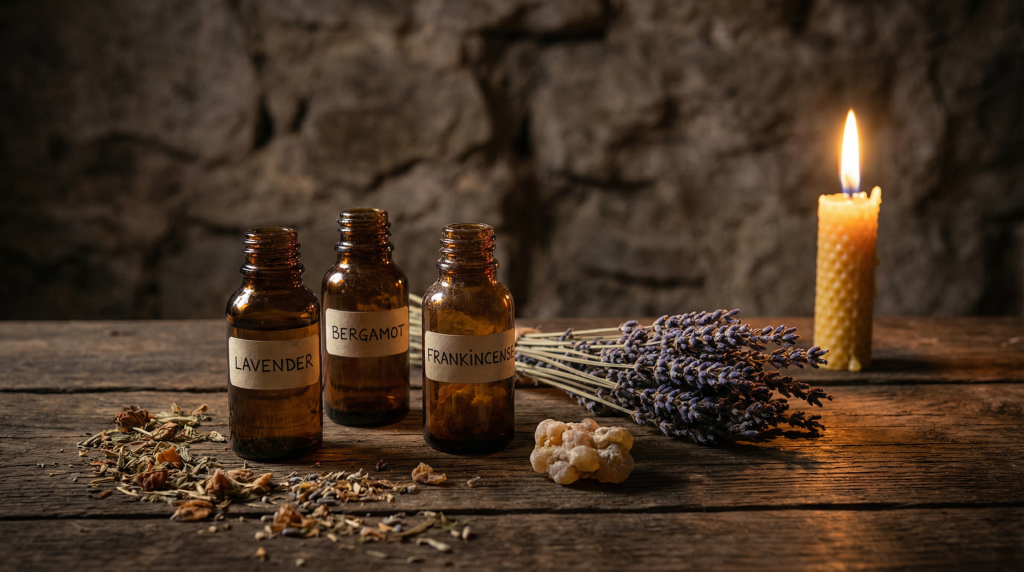
Here are the three most potent, clinically validated aromatic compounds for regulating the HPA axis and protecting your nervous system.
1. Lavender (Lavandula angustifolia): The Cortisol Brake
Lavender is often dismissed as a mere relaxation aid. The clinical data tells a much more aggressive story.
A landmark study published in the Journal of Natural Medicines demonstrated that inhalation of lavender essential oil significantly reduces both subjective anxiety and objective blood cortisol levels, even in patients facing extreme stress (like impending open-heart surgery).
The active compounds, linalool and linalyl acetate, interact directly with the neurotransmitter GABA, dampening the excitability of the nervous system. It acts as a pharmacological brake on the HPA axis.
2. Bergamot (Citrus bergamia): The Autonomic Reset
While lavender sedates, bergamot resets.
Research published in Forschende Komplementärmedizin (Research in Complementary Medicine) found that bergamot essential oil aromatherapy significantly alters parasympathetic nervous system activity.
It actively lowers salivary cortisol levels and shifts the body out of sympathetic “fight or flight” mode and into parasympathetic “rest and digest” mode. It is a biological override switch for chronic anxiety.
3. Frankincense (Boswellia carterii): The Neuro-Protector
Frankincense resin has been traded for millennia, often valued higher than gold. Modern science shows us why.
The active components, incensole acetate and boswellic acids, are potent anti-inflammatories. But more importantly, research indicates they have profound neuroprotective properties.
They cross the blood-brain barrier and actively reduce neuro-inflammation—the exact type of inflammation caused by chronic stress and linked to cognitive decline. Frankincense doesn’t just calm the mind; it physically protects the brain’s architecture.
Practical Implementation: The Fortress Protocol
Knowledge without application is useless. Here is how you implement these clinical findings into a daily protocol to protect your nervous system.
Step 1: The Morning Reset (Bergamot)
Cortisol naturally spikes in the morning (the cortisol awakening response). When you are under chronic stress, this spike is exaggerated, leading to morning anxiety.
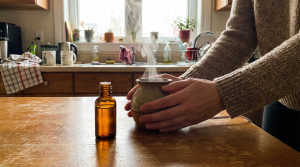
Diffuse 4-5 drops of high-quality Bergamot essential oil in your primary living space for the first 30 minutes of your day. Do not consume the news during this window. Let the aromatic compounds engage your parasympathetic nervous system before the world demands your attention.
Step 2: The Acute Intervention (Frankincense)
Keep a roller bottle of diluted Frankincense (diluted in a carrier oil like fractionated coconut oil) with you. When you feel the physical symptoms of the HPA axis activating—tight chest, shallow breathing, racing thoughts—apply it directly to your pulse points (wrists and the base of the neck).
Take three slow, deep breaths, inhaling the aroma directly. You are using the olfactory nerve to send an immediate “stand down” signal to your amygdala.
Step 3: The Evening Brake (Lavender)
To repair the damage of chronic stress, you need deep, restorative sleep. 45 minutes before bed, diffuse 5 drops of Lavender essential oil in your bedroom.
Alternatively, place 2 drops on a cotton ball and slip it inside your pillowcase. The continuous inhalation of linalool throughout the night will suppress nighttime cortisol spikes and deepen your sleep architecture.
Disclaimer: Always ensure you are using 100% pure, therapeutic-grade essential oils. Synthetic fragrances do not contain the active chemical compounds required for these physiological effects. Always consult with a healthcare professional before beginning any new health protocol, especially if you are pregnant, nursing, or have a medical condition.
The Sovereignty Principle: Your Body is the Last Empire
The Vikings built the most expansive global network of their age—and then voluntarily walked away from it. The world didn’t wait for them to return. It moved on.
America is making the same choice today. The global systems we relied on are fracturing. The supply chains are retreating. The empire is abdicating.
You cannot stop this macro-level collapse. But you can control your micro-environment.
Your body is the only empire that cannot be abdicated. While global systems collapse and retreat, your health sovereignty is the one thing you build and keep. The Vikings who survived the end of their era built their resilience from the inside out.
They didn’t wait for the longships. They built their own fortresses.
Understanding the historical parallels of imperial retreat is the first step to recognizing the reality of our current situation. But recognition must be followed by action.
You must build systems that don’t rely on fragile global networks. This means developing systems-level self-reliance in every aspect of your life, from your food supply to your medical care.
And it requires taking actionable steps today to insulate your family from the inevitable shocks of a retreating empire.
Protect your nervous system. Build your biological fortress. Because when the empire walks away, you are the only one left to defend the gates.